

Introduction: Why Sourcing Eco-Friendly Food Packaging Is More Complex Than It Looks
The United Nations Environment Programme defines “single-use plastic products” as “a collective term for various types of products typically used only once before being discarded or recycled,” including food packaging, bottles, straws, containers, cups, cutlery, and shopping bags. In recent years, the extensive use and indiscriminate disposal of single-use plastics have transformed “white pollution” into a global environmental challenge. The public nuisance caused by plastic waste has drawn widespread societal concern. In response, international organizations and numerous countries and regions are continuously refining their “plastic restriction” and “plastic ban” regulations based on their specific circumstances. Given this situation, demand for biodegradable tableware has surged. However, across the entire market, significant quality disparities exist among different products. This leads to numerous challenges for customers sourcing disposable eco-friendly tableware in China. To address this, DAILYECO have compiled a list of common issues encountered by customers during procurement and outlined our approach as a Chinese supplier to overcome them.
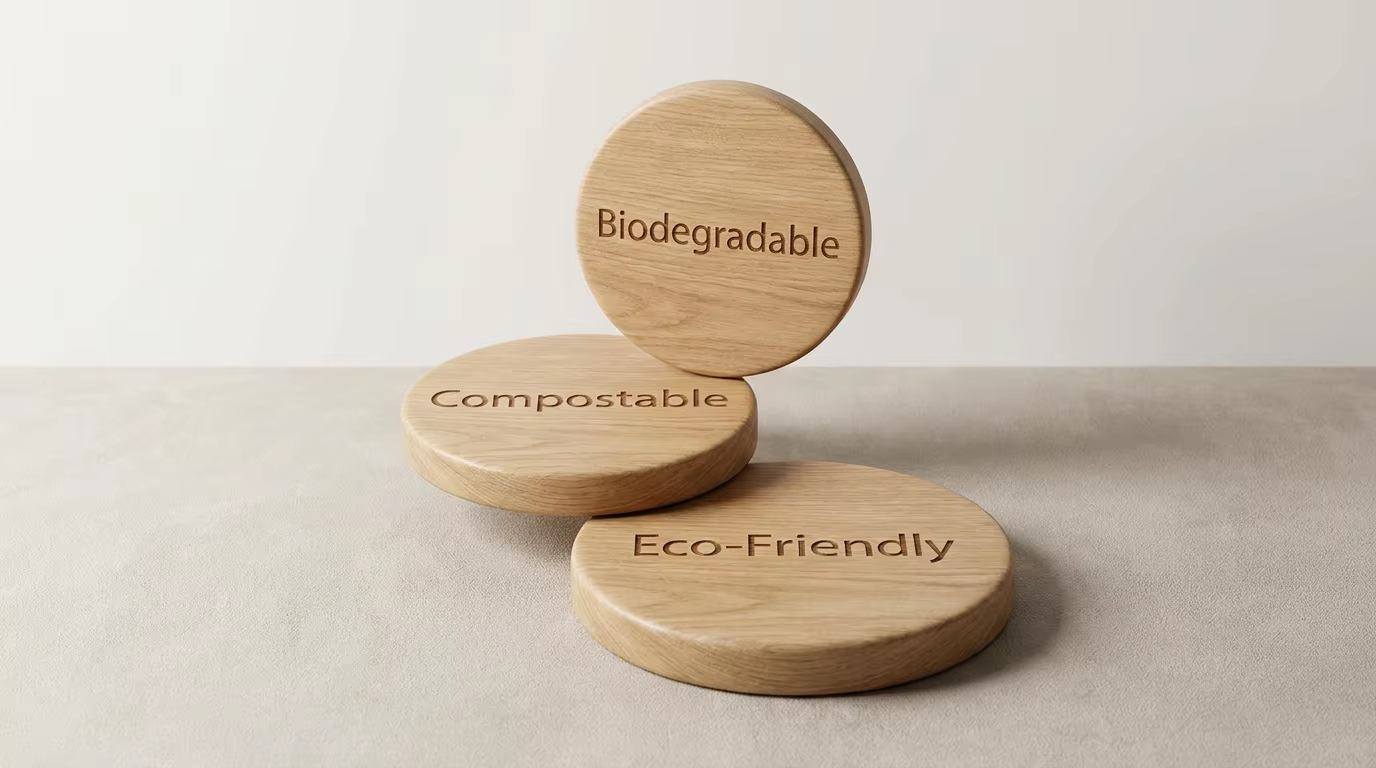
Question 1: Confusing “Biodegradable,” “Compostable,” and “Eco-Friendly”
The current situation is that many products casually use terms like “biodegradable,” “compostable,” and “eco-friendly” in their marketing. While these terms all appear to relate to environmental attributes, this leads to significant confusion among buyers when procuring goods. However, at the regulatory level, their strictness is entirely different. “Eco-friendly” is a broad descriptive term with no legal attributes whatsoever; “Biodegradable” indicates that the product can be broken down by microorganisms in nature, but without any specified timeframe or environmental constraints; ‘Compostable’ refers to products that will fully decompose within a defined period (90 days) under specific composting conditions, leaving no toxic residues and causing no environmental harm. Non-specialist buyers are easily misled by terms that “sound environmentally friendly.”
We are a specialized manufacturer of eco-friendly biodegradable tableware and sustainable takeout food containers. Our expertise is well-established. Recognizing that different countries and regions currently have varying standards for eco-friendly products, we clearly specify the properties of each material when clients inquire about different raw material products. We recommend products based on the customer’s target market and actual application scenarios.
Tips:
Currently, there is no universally accepted definition of environmental protection worldwide, as different countries and regions have varying standards. In light of this, we offer two helpful tips for guests seeking further understanding.
1.Regulatory differences among countries regarding these concepts
The European Union imposes the strictest and most explicit regulations on environmentally friendly products. Any item labeled “compostable” must comply with the EN 13432 standard, meaning it must achieve complete decomposition under industrial composting conditions without leaving any toxic residues and without compromising the quality of the compost. The term “biodegradable” cannot be used as a standalone promotional claim, as it would be deemed misleading advertising. “Eco-friendly” is not permissible as a formal compliance statement. If used in product promotion, it must be supported by evidence; otherwise, it violates “greenwashing” regulations.
The United States has numerous and fragmented enforcement standards for these environmental attributes. The term “compostable” requires compliance with ASTM D6400/D6868 standards, with products needing to pass testing to obtain BPI certification. ‘Biodegradable’ is permitted for market use, but special caution is required to avoid implying rapid or complete decomposition. “Eco-friendly” is considered marketing language, subject to the FTC Green Guides, and must not mislead consumers.
The regulatory framework in Canada follows a logic similar to that of the United States but adopts a more cautious approach. For the term “compostable,” it relies on ASTM and ISO standards. Regarding ‘biodegradable’ and “eco-friendly,” however, it takes a more conservative stance, requiring verifiable evidence to substantiate claims when using these terms.
Australia and New Zealand have more explicit requirements for “compostable” products, which must comply with local standards AS 4736 or AS 5810 to be used. While there are no specific standards for “biodegradable,” regulatory authorities emphasize maintaining vigilance and caution against arbitrary use that could mislead consumers.
Asia also has varying usage standards for these terms. Japan, in particular, enforces stricter requirements for “compostable” labeling, mandating products meet industrial composting standards (JIS Z 7211). South Korea primarily references KOSHA standards while requiring products to obtain third-party certification and comply with ISO 17088. Indonesia mandates products meet international standards like ISO 17088 and ASTM D6400 to use this attribute. Regarding the “biodegradable” attribute, no region in Asia has a clear definition, generally referring to products that degrade within a specified timeframe. For the term “eco-friendly,” most countries still define it as a marketing claim. However, Japan specifically requires reliable evidence to support its use. Countries like South Korea, China, and Indonesia mandate that companies provide relevant environmental impact metrics.
2.Risks associated with selecting products with incorrect standard labels
Products bearing incorrect labels may face penalties and consequences including: being deemed misleading eco-claims and consequently removed from the market or even banned from sale. Under consumer protection laws of various countries, companies may incur substantial fines of varying severity, which can have a lasting impact on consumer trust in the brand.
Therefore, the misuse of these product attributes is no longer merely a simple marketing issue, but rather an industry-wide compliance risk.
Question 2:Choosing Products Based on Price Only
Currently, many customers focus solely on product pricing when selecting suppliers, overlooking critical attributes such as grammage, manufacturing processes, and heat resistance. This tendency becomes particularly pronounced when buyers must choose a supplier quickly, often making the “lowest unit price” the sole deciding factor. However, prioritizing price while disregarding deeper technical specifications can lead to unforeseen risks—such as increased breakage rates during transportation or deformation during use.
As a manufacturer specializing in eco-friendly tableware, our responsibility extends beyond simply providing product quotes to our clients. More importantly, we help them make the right choices. When providing quotes, we deliver transparent product specification sheets detailing grammage, material types, packaging specifications, and other relevant data. Furthermore, we recommend tailored product specifications based on the diverse usage scenarios provided by our clients. During the prototyping phase, we simulate real-world usage conditions to rigorously test product performance. Our professional sales team clearly explains the distinctions between products of varying grammages and manufacturing processes, ensuring clients fully understand the origins of price variations.
Tips:
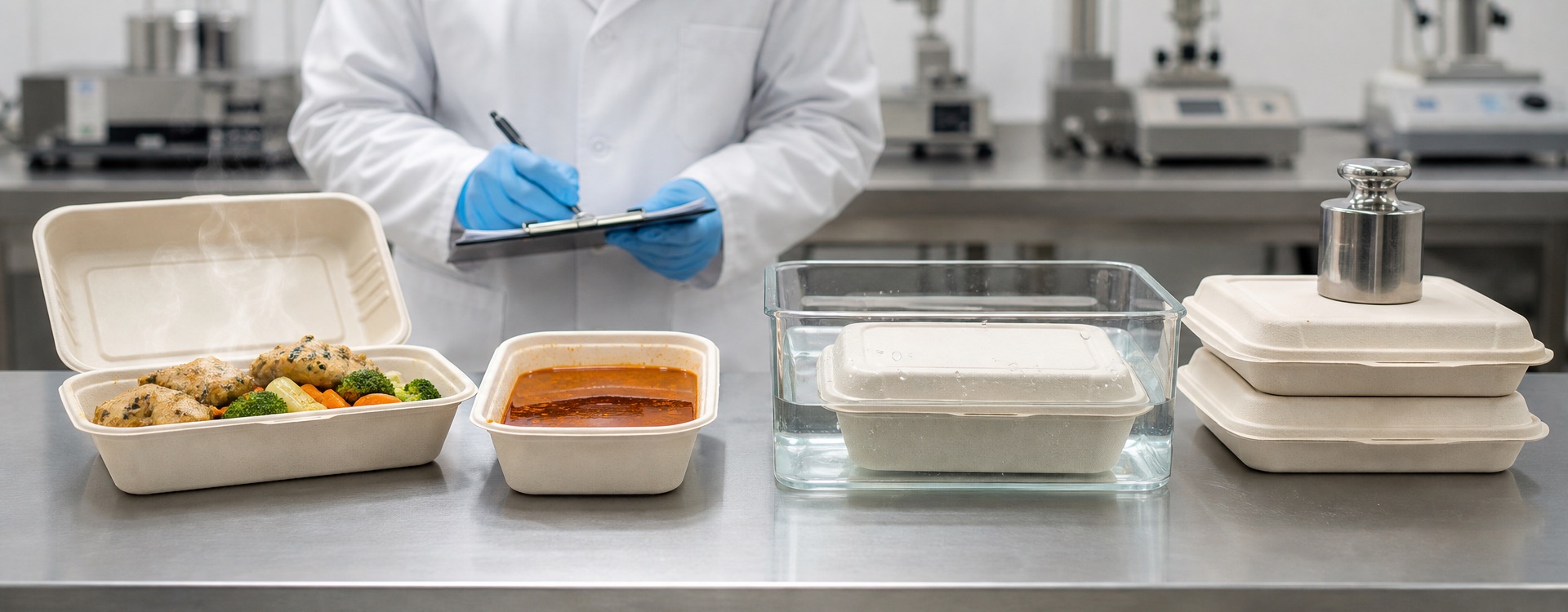
When receiving samples from different suppliers, customers need to conduct various sample tests to select the most suitable product. The following are recommended testing standards. Systematic sample testing includes the following points:
- Weight per unit area, thickness, and consistency of molding for individual products. Inspect the product surface for cracks, pores, or uneven compression.
- Heat resistance testing: After holding hot food or pouring hot water for 15-30 minutes, check for deformation, softening, or loss of structural integrity.
- Oil and water resistance testing: After holding high-fat foods or adding cooking oil/water and letting stand for 30 minutes, check for oil or water seepage.
- Structural Lightness and Load-bearing Test: Stack multiple products and place a weight on top to check for collapse.
- Food Contact Safety and Odor Test: Inspect the product itself for any foreign odors; after holding food for 30 minutes, check if it affects the original flavor of the food.
Question 3:Overlooking Moisture, Oil & Heat Resistance
Many customers focus solely on product appearance when comparing quotes or evaluating samples, overlooking actual performance characteristics. While appearance is the most intuitive and easily assessed factor, basing decisions solely on looks can compromise the product’s performance in real-world applications. Issues like softening, deformation, leakage, or collapse won’t be revealed during “static sample displays.”
As a professional manufacturer of disposable eco-friendly tableware, we optimize existing molds and processes for each product’s specific application. We support water, oil, and heat testing for diverse products. When sending samples to clients, we clearly specify the product’s intended use and performance rating to prevent mismatches where similar appearances lead to incompatible functionality.

Question 4:Ignoring Food Safety & Compliance Standards
When selecting biodegradable eco-friendly tableware and disposable food packaging, customers sometimes focus solely on environmental attributes while overlooking food contact safety. This oversight can lead to risks such as product odors or taste alterations after direct contact with food, the release of unstable substances from materials under high-temperature or high-oil conditions, or even non-compliance with target market food contact regulations. Such issues may result in customs clearance problems or sales risks for the goods.
As a professional manufacturer of biodegradable tableware and food packaging, DAILYECO select raw materials that meet food contact standards and strictly control the entire production process to eliminate problematic products at the source. We also provide relevant test reports tailored to different market requirements to support compliance.
Question 5:Lack of After-Sales Support
During the initial phase, key factors such as raw materials, pricing, specifications, and quantities are determined for the finished products. Once the bulk order is completed, the customer’s primary concern shifts to whether the goods can arrive at the port as scheduled and clear customs smoothly. Any issues arising during transportation or customs clearance can easily cause anxiety for the customer and may even impact future collaborations.
As an experienced Chinese manufacturer of disposable eco-friendly tableware, DAILYECO integrate logistics and customs clearance as integral components of our comprehensive service. We clearly define trade terms prior to shipment, delineate responsibilities among all parties, and provide transparent, compliant export documentation. We rigorously supervise cargo loading and continuously monitor shipment status. Should any issues arise, we respond immediately and deliver solutions—because our mission is to build lasting partnerships with clients, not conduct one-time transactions.

Conclusion: How to Choose the Right Eco-Friendly Food Packaging Manufacturer in China
Sourcing disposable eco-friendly food packaging from China is far more complex than simply comparing prices or reviewing product images. It requires a clear understanding of material definitions, regulatory compliance, performance standards, and long-term supply reliability.
As global sustainability and food safety regulations continue to evolve, importers and brand owners face increasingly stringent responsibilities. Misusing eco-claims, neglecting food contact compliance, or selecting products that fail in real-world use can lead to financial losses, shipping delays, regulatory penalties, and long-term brand damage.
Therefore, selecting the right manufacturer means partnering with suppliers who offer more than just a quote. A reliable partner should clearly explain material properties, understand compliance requirements for target markets, provide transparent product specifications, support systematic sample testing, and maintain responsiveness throughout production, shipping, and after-sales service.
Eco-friendly tableware is more than just a product—it embodies a brand’s commitment to sustainability, safety, and social responsibility. Choosing DAILYECO as your professional and experienced manufacturer not only minimizes procurement risks and safeguards your market reputation but also builds a more stable and sustainable supply chain system for the future.
DAILYECO firmly believe that in the global marketplace, true value stems not from the lowest price—but from the right partnership.