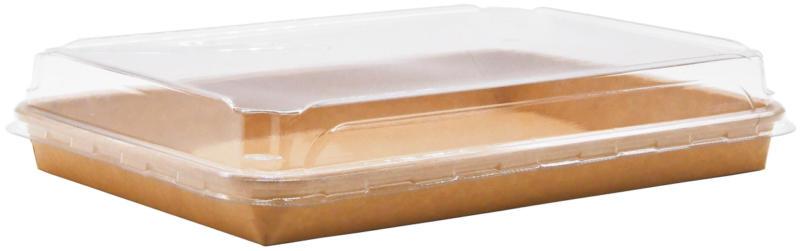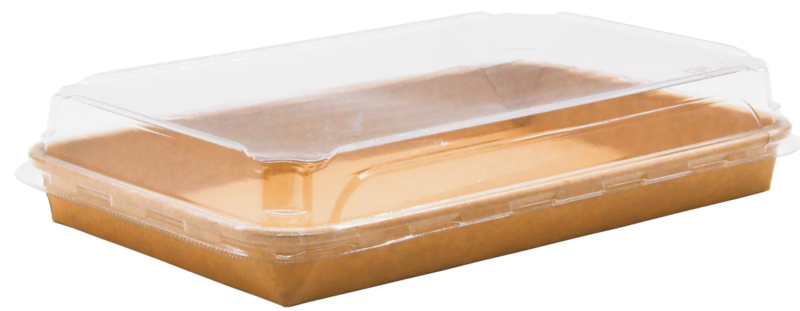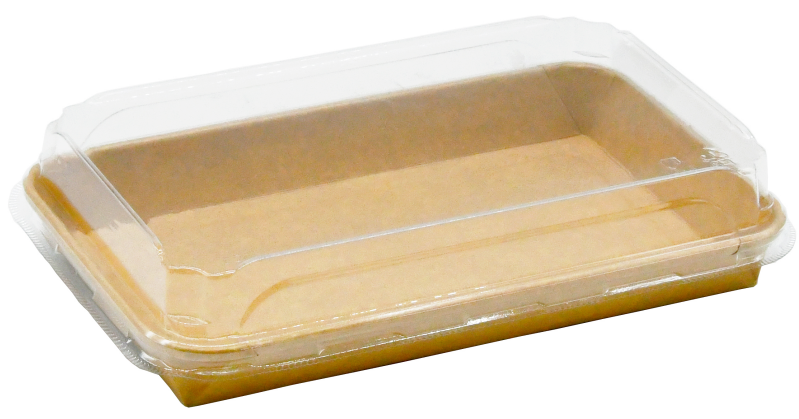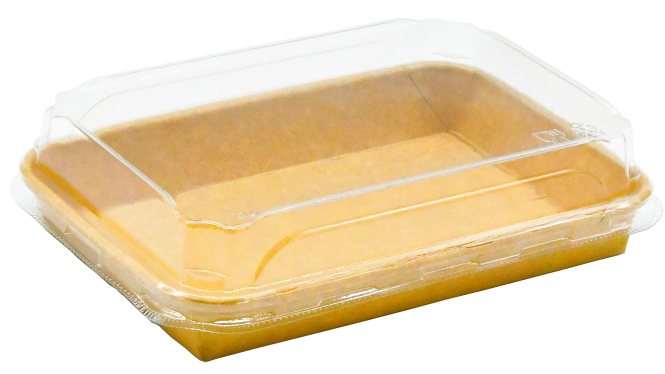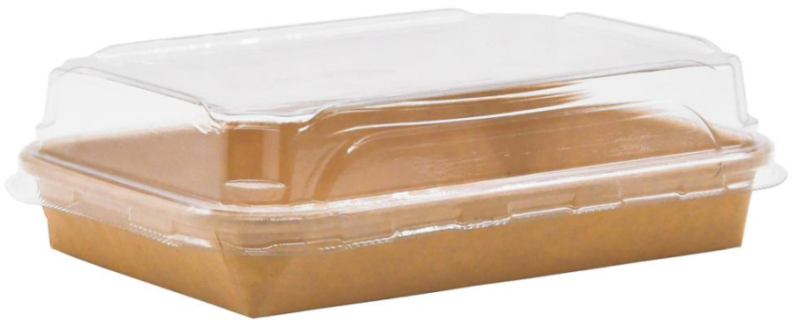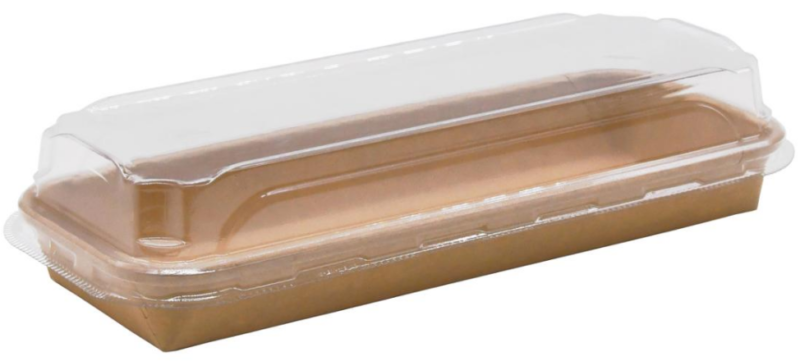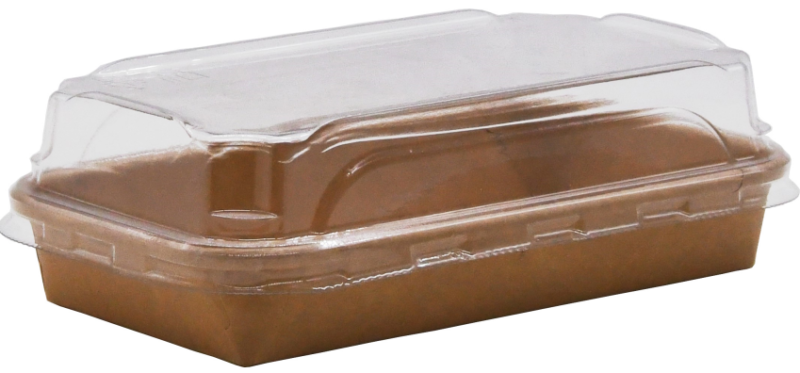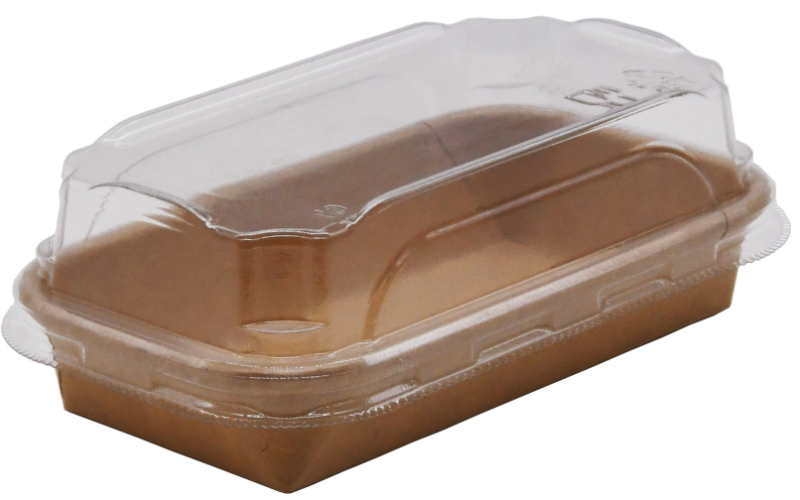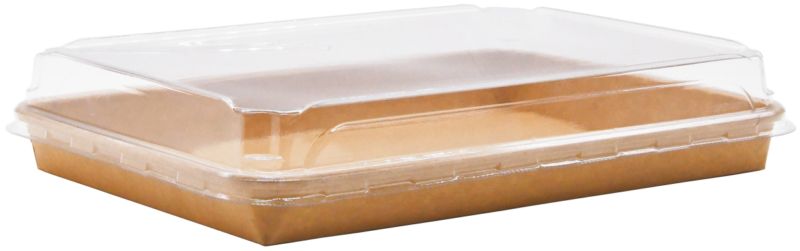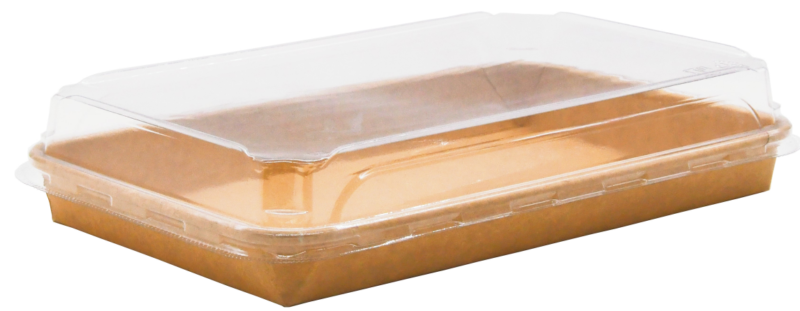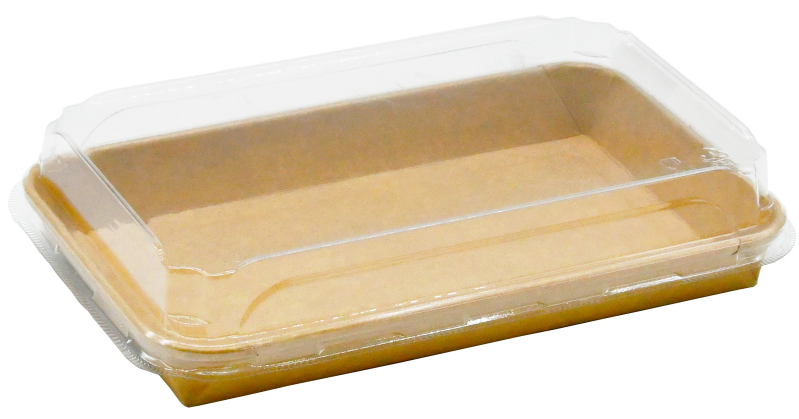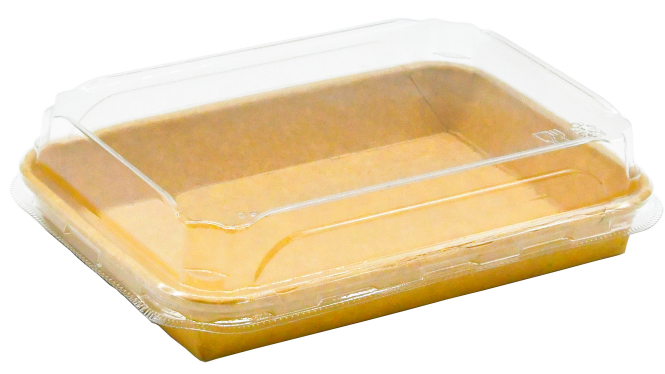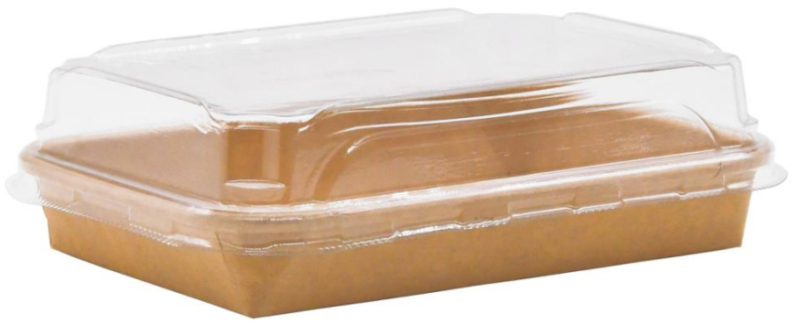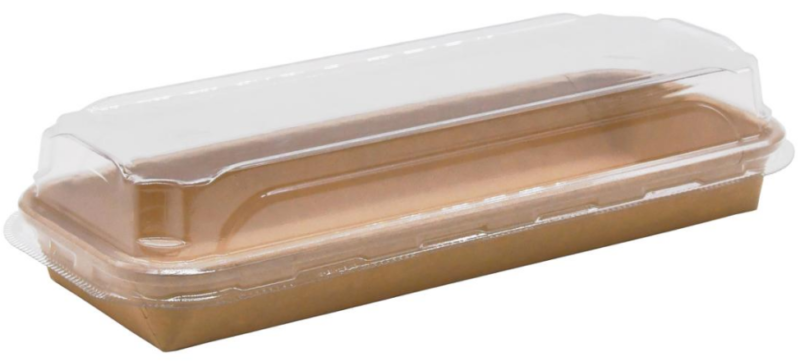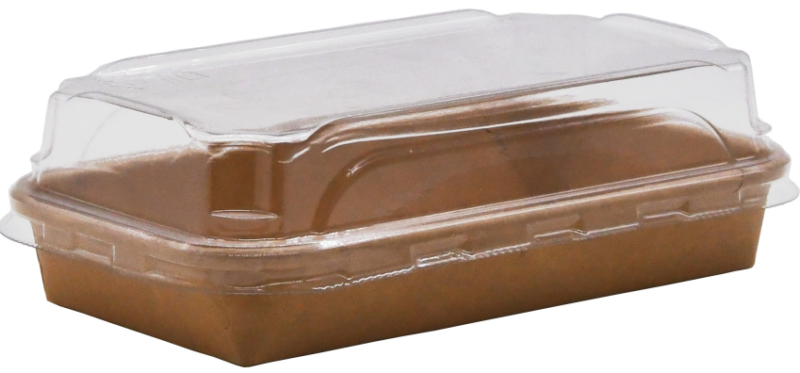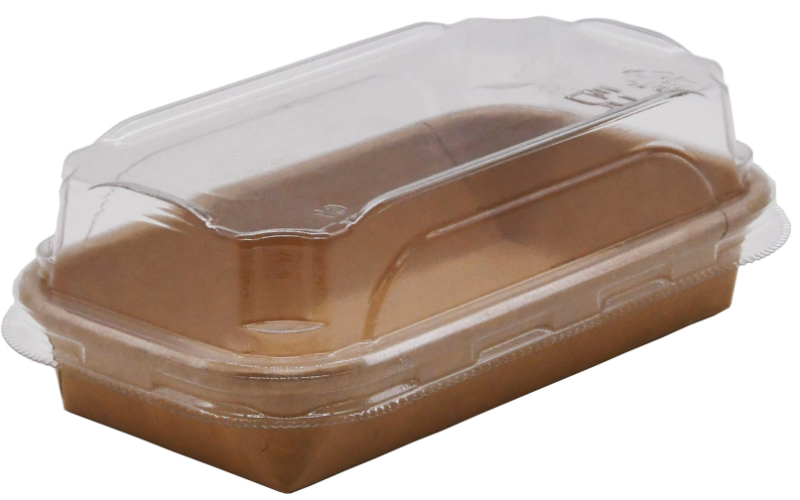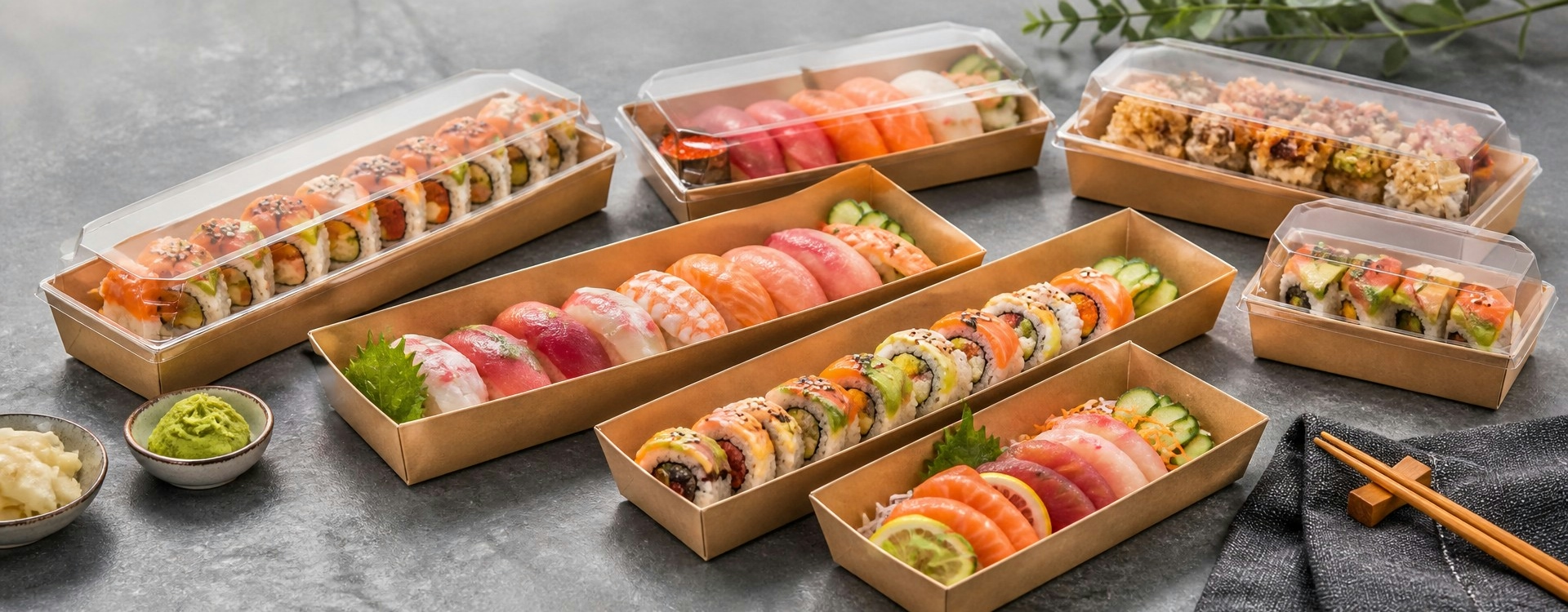
Item | Information |
Collection Keyword | Paper Sushi Tray |
Product Format | Shallow paperboard presentation tray for sushi, rolls, sashimi, nigiri, sides, and chilled assortments |
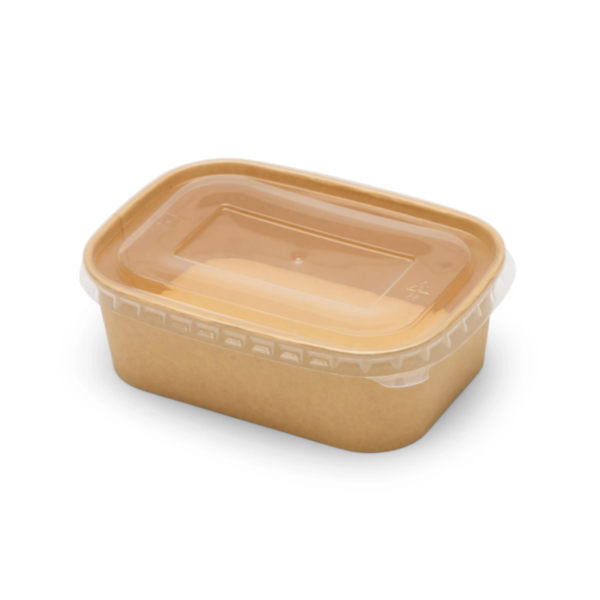
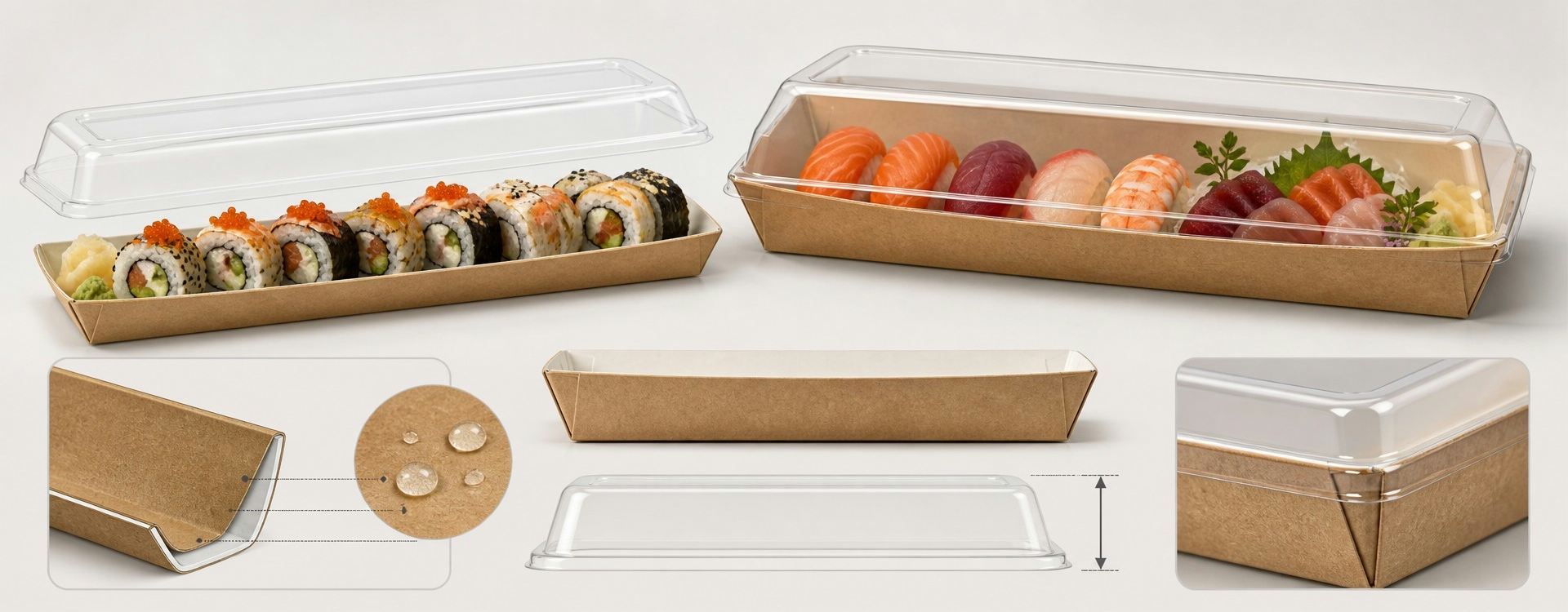
Common Materials | Current catalog: 300 gsm kraft paper + 18 gsm PE-lined bases; matching anti-fog PET lids |
Common Formats | Eight rectangular or elongated rectangular base sizes; top dimensions from 135 × 75 mm to 251 × 178 mm |
Protection Options | Eight size-matched anti-fog PET lids; each lid is 32 mm high |
Typical Channels | Sushi restaurants, takeaway, delivery, chilled retail, catering, chef-led tasting, meal kits, travel catering, and private label |
Customization | Dimensions, paperboard, barrier, surface color, printing, lid interface, labels, pack count, and cartons |
Supply Type | B2B wholesale, OEM/ODM development, private label, and export-order support |
Critical Qualification | Food-contact, chilled-use, lid-fit, barrier, recycling, composting, and certification claims are SKU- and market-specific |
DAILYECO’s current paper sushi tray catalog includes eight rectangular or elongated rectangular kraft paper sushi trays made from 300 gsm kraft paper with an 18 gsm PE lining, plus eight size-matched anti-fog PET sushi tray lids. Custom printing and other structural developments remain subject to technical review, minimum order quantity, and sample approval.
A paper sushi tray is a shallow food-presentation base made primarily from converted paperboard and designed to hold sushi, sashimi, maki, nigiri, rolls, side items, or tasting assortments. Depending on the SKU, it may be supplied as an open serving tray or matched with a separate transparent lid, sleeve, film, band, or overbox for protection and display.
Often grouped with paper food trays, paper trays for food, or paper food serving trays, the format is selected for its clean presentation, printable surfaces, shallow profile, and suitability for portion-controlled chilled food. A paperboard base is not automatically equivalent to a sealed plastic sushi container; the closure and transport system must be evaluated separately.
The performance of a paper sushi tray depends on its dimensions, usable food area, paperboard grade, basis weight, stiffness, edge and corner design, barrier or lamination, ink and adhesive system, food temperature, condensation, sauce exposure, holding time, stacking, and the fit of any lid or secondary package.
Paper sushi trays combine an organized presentation surface, multiple portion formats, paper-based branding opportunities, and compatibility with chilled takeaway or retail workflows. Professional buyers should evaluate measurable product and packaging-system requirements instead of relying on broad labels such as premium, eco-friendly, leakproof, or food grade without SKU-specific evidence.
The following table explains the features that normally influence sourcing, real-food testing, lid matching, sample approval, packing efficiency, retail display, and repeat-order consistency.
Feature | Performance | Explanation |
Paperboard Construction | Food-Grade Paperboard Construction | Manufactured from quality food-grade paperboard using die-cutting, creasing, folding, and forming technology. |
Structural Strength | Stable Folded Structure for Food Service | Strong folded construction suitable for serving a wide range of foods. |
Heat Resistance | SKU-Specific Hot-Food and Microwave Compatibility | Selected paper sushi trays may be suitable for qualified microwave-heating applications, subject to product-specific time and temperature limits. |
Cold Food Performance | Suitable for Chilled Food Service | Maintains stability when serving salads, desserts, fruits, and chilled dishes. |
Freezer Compatibility | Selected SKUs Suitable Down to −20°C | Selected SKUs may be suitable for chilled or frozen-food applications down to −20°C, subject to product-specific verification. |
Oil & Grease Resistance | Resists light Oil Penetration | Helps prevent oil penetration during everyday meal service |
Moisture Resistance | Short-Term Moisture Resistance for Foodservice | Maintains structural integrity during normal foodservice use. |
Food Contact Safety | Food-Contact-Compliant Material System | Produced using food-contact-compliant paperboard, coatings, inks, and adhesives. |
Product Consistency | Uniform Dimensions and Reliable Batch Quality | Uniform dimensions, stable folding structures, and reliable quality for commercial applications. |
OEM Customization | Custom Sizes, Printing, and Packaging Available | Custom sizes, die-lines, paperboard options, printing, branding, and packaging solutions are available. |
Product Portfolio | Multiple Sizes, Materials, and Paper Tray Formats | Available in kraft paper boat trays, paper sushi trays, paper food trays, hot dog paper trays, and multiple capacity options. |
Commercial Applications | Suitable for Foodservice, Takeaway, and Retail | Suitable for restaurants, catering, concessions, food trucks, takeaway, retail, and event foodservice. |
Sustainability Options | Paper-Based Packaging Material Options | Manufactured from paper-based materials, with material and coating options that can support customers’ sustainable packaging programs. |
The current catalog uses a natural kraft presentation surface with a PE-lined food-contact side. Custom colors or printed finishes can be evaluated separately, but color, print coverage, coating, ink, and the intended food-contact area must be approved for the exact custom specification.
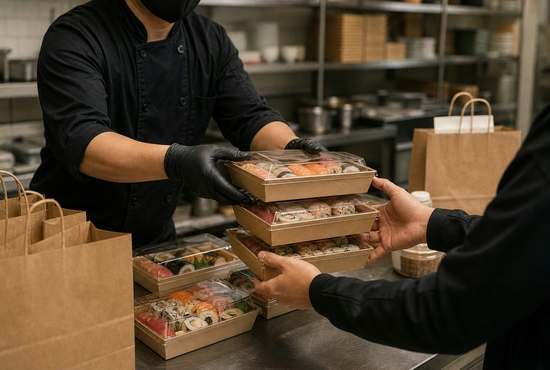
For takeaway and delivery, the paper base must be evaluated as part of the complete packaging system. A lid, band, sleeve, film, bag, or overbox may be required for hygiene, tamper evidence, stacking, and transport; none of those functions should be assumed from the tray base alone.
The shallow format can make sushi easier to arrange and inspect, but fit is critical. Oversized trays allow pieces to move, while undersized trays can compress rolls, disturb garnishes, interfere with lid closure, or reduce the presentation quality expected by restaurants and retail customers.
Growth in sushi restaurants, prepared-food counters, supermarket meal programs, delivery platforms, catering, and convenience retail has increased demand for packaging that presents chilled food clearly and moves efficiently from preparation to display or handoff.
Paper sushi trays fit this service model when buyers want a paper-based base, controlled portion area, printable branding, and a shallow presentation format. They can be paired with an appropriate cover or secondary package when product protection and transport are part of the requirement.
Paperboard also offers a familiar material story, but environmental claims must match the exact fiber source, recycled content, coating or lamination, certification scope, food residue, and local collection system. Paper appearance alone does not prove recyclability or compostability.
Commercial adoption is also supported by a practical size ladder. The current range covers eight rectangular or elongated rectangular bases with top dimensions from 135 × 75 mm to 251 × 178 mm, each paired with a 32 mm-high anti-fog PET lid in the same top dimensions. Custom artwork, retail packs, and carton programs can be reviewed separately.
Sushi packaging teams increasingly evaluate the complete operating system: product presentation, chilled-food performance, lid fit, condensation, preparation speed, customer handling, material documentation, claim language, carton efficiency, landed cost, and end-of-use conditions.
Within this evaluation, paper food trays are considered when the paperboard base can provide the required appearance and structural support while a separately selected lid or secondary package provides the necessary protection and visibility.
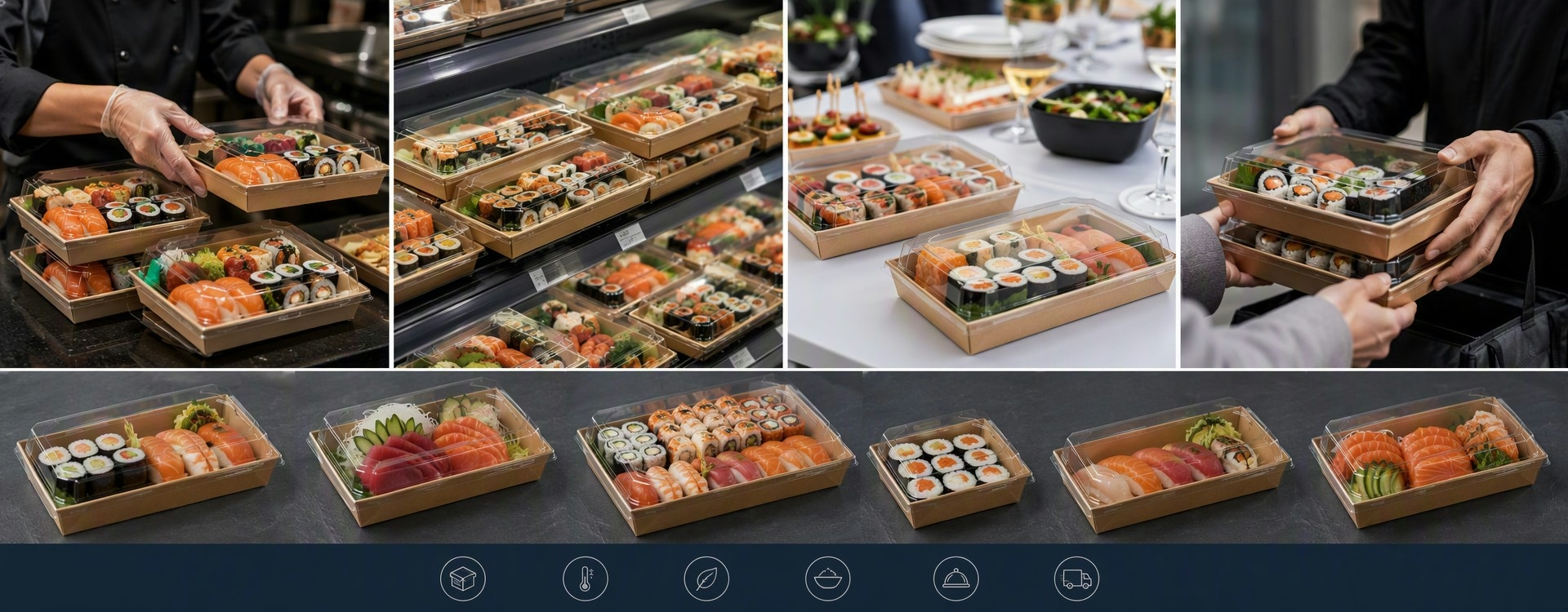
Operators want packaging that fits preparation counters and cold displays, separates easily during peak service, holds the planned assortment without movement, and supports a clean handoff to customers.
Rigid plastic sushi trays remain appropriate when high transparency, integrated lid fit, or moisture resistance is the priority. A paper sushi tray is selected when a paper-based base, printability, and differentiated visual presentation better match the brand and the validated distribution cycle.
This makes disposable paper food trays relevant to sushi restaurants, grab-and-go programs, prepared-food counters, tasting events, and private-label retail—provided the selected tray and cover are tested together.
Importers and food brands increasingly request information about fiber source, recycled content, forestry certification, food-contact compliance, coatings or laminations, inks, adhesives, lid materials, and the appropriate end-of-use message for each component.
Terms such as recyclable, recycled, biodegradable, compostable, plastic-reduced, or responsibly sourced must be qualified when limitations apply. A barrier or clear lid that improves performance may also change collection, separation, and labeling instructions.
The tray influences how sushi is arranged, carried, displayed, opened, and eaten. Usable base area, rim height, surface friction, color contrast, lid clearance, condensation behavior, and stack stability all affect the customer experience.
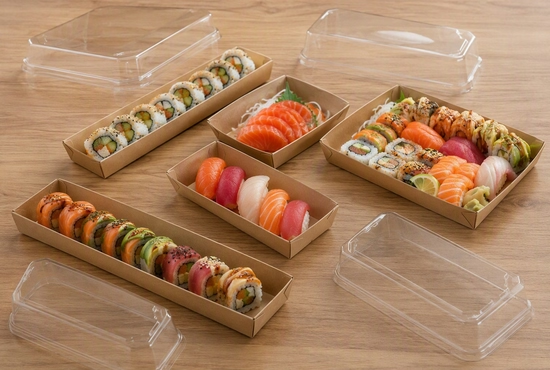
Application-specific options in the current catalog include compact 135 × 75 mm and 156 × 87 mm bases for tasting portions, elongated 217 × 87 mm formats for rolls, and wider 217 × 134 mm, 237 × 148 mm, or 251 × 178 mm bases for combination sets and shared assortments.
Custom printing and structural development help restaurant chains, distributors, retailers, and private-label brands distinguish a standardized product while keeping food fit, labeling, and packing under control.
The strongest result connects the visual concept to a manufacturable paperboard specification, compatible protection system, verified chilled-food performance, realistic minimum order, and repeatable approval standard.
The correct sushi package depends on the food assortment, portion, temperature, condensation, sauce exposure, holding time, transport distance, product visibility, stacking, tamper-evidence target, disposal route, and total landed cost.
Paper sushi trays are appropriate when a paperboard presentation base and a compatible protection system match the operating conditions. Other materials may be better when maximum transparency, high moisture resistance, integrated sealing, or a one-material package is essential.
Use the following guide as a starting point, then validate the exact tray, lid, label, and food together.
Choose Paper Sushi Trays If You:
Choose Plastic Sushi Trays If You:
Choose Molded Fiber Food Trays If You:
DAILYECO supplies paper sushi trays for sushi restaurants, foodservice distributors, caterers, hotels, supermarkets, convenience retailers, importers, and private-label packaging buyers.
The current product family contains eight kraft paper sushi tray bases and eight matching anti-fog PET sushi tray lids. Base top dimensions range from 135 × 75 mm to 251 × 178 mm; each base is 24 mm high, and each corresponding lid is 32 mm high.
Product selection begins with the actual assortment and route to the customer. The 135 × 75 mm or 156 × 87 mm top sizes can be evaluated for compact portions, the 217 × 87 mm format for rolls, and the 217 × 134 mm, 237 × 148 mm, or 251 × 178 mm formats for mixed or larger assortments. Final food fit and lid clearance still require sample testing.
Pictures | Product | Size | Material & Basis Weight | Packing | CTN Size |
| Paper Kraft Sushi Tray With PE Lined | Top: 251 × 178 mm | 300 gsm Kraft Paper + 18 gsm PE | 100 pcs/bag | 49 × 28 × 38.5 cm |
| Paper Kraft Sushi Tray With PE Lined | Top: 237 × 148 mm | 300 gsm Kraft Paper + 18 gsm PE | 100 pcs/bag | 65 × 26 × 47.5 cm |
| Paper Kraft Sushi Tray With PE Lined | Top: 217 × 134 mm | 300 gsm Kraft Paper + 18 gsm PE | 100 pcs/bag | 50 × 31 × 46.5 cm |
| Paper Kraft Sushi Tray With PE Lined | Top: 180 × 125 mm | 300 gsm Kraft Paper + 18 gsm PE | 150 pcs/bag | 48 × 38.5 × 40 cm |
| Paper Kraft Sushi Tray With PE Lined | Top: 161 × 111 mm | 300 gsm Kraft Paper + 18 gsm PE | 150 pcs/bag | 48 × 36 × 36.5 cm |
| Paper Kraft Sushi Tray With PE Lined | Top: 217 × 87 mm | 300 gsm Kraft Paper + 18 gsm PE | 150 pcs/bag | 48 × 29 × 45.5 cm |
| Paper Kraft Sushi Tray With PE Lined | Top: 156 × 87 mm | 300 gsm Kraft Paper + 18 gsm PE | 100 pcs/bag | 47.5 × 33.5 × 39 cm |
| Paper Kraft Sushi Tray With PE Lined | Top: 135 × 75 mm | 300 gsm Kraft Paper + 18 gsm PE | 100 pcs/bag | 49 × 29 × 33.5 cm |
| Anti-Fog PET Sushi Tray Lid | Top: 251 × 178 mm | PET | 100 pcs/bag | 53 × 28 × 38.5 cm |
| Anti-Fog PET Sushi Tray Lid | Top: 237 × 148 mm | PET | 100 pcs/bag | 64 × 29 × 50 cm |
| Anti-Fog PET Sushi Tray Lid | Top: 217 × 134 mm | PET | 100 pcs/bag | 59 × 38 × 47.5 cm |
| Anti-Fog PET Sushi Tray Lid | Top: 180 × 125 mm | PET | 150 pcs/bag | 55 × 32 × 58.5 cm |
| Anti-Fog PET Sushi Tray Lid | Top: 161 × 111 mm | PET | 150 pcs/bag | 51 × 38 × 52 cm |
| Anti-Fog PET Sushi Tray Lid | Top: 217 × 87 mm | PET | 150 pcs/bag | 57.5 × 34.5 × 46 cm |
| Anti-Fog PET Sushi Tray Lid | Top: 156 × 87 mm | PET | 100 pcs/bag | 66.5 × 34.5 × 38.5 cm |
| Anti-Fog PET Sushi Tray Lid | Top: 135 × 75 mm | PET | 100 pcs/bag | 58 × 36.5 × 35.5 cm |
Custom projects may adjust external and usable dimensions, rim or sidewall profile, board grade, barrier system, surface color, artwork, lid interface, label area, packing quantity, and master-carton configuration.
Final availability, minimum order quantity, lead time, food-contact scope, lid compatibility, and performance claims must be confirmed for the selected standard or custom SKU.
DAILYECO supports OEM and ODM projects for custom paper sushi trays, kraft paper tray formats, and private-label chilled-food packaging.
A useful customization brief connects tray dimensions, paperboard color and basis weight, surface or barrier treatment, fold and edge design, lid or secondary-packaging interface, artwork, label position, pack count, carton marks, and container-loading needs.
A signed drawing, approved physical sample, material specification, artwork file, packing standard, and acceptance criteria should form one controlled approval package.
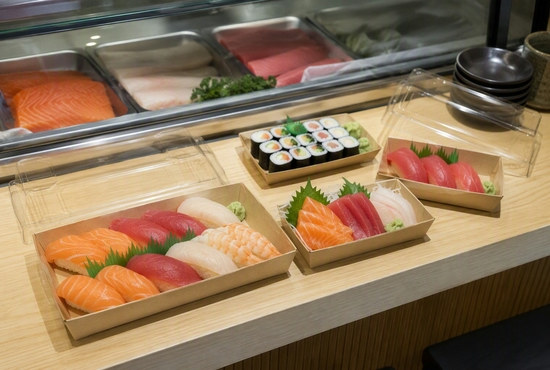
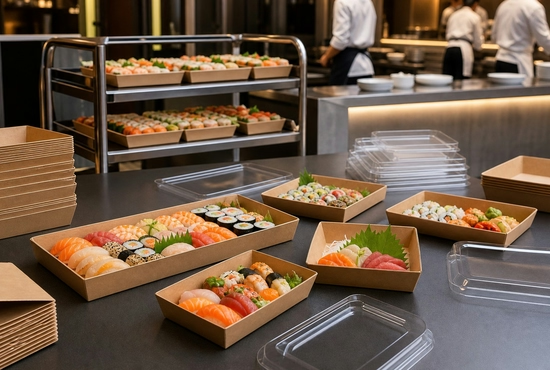
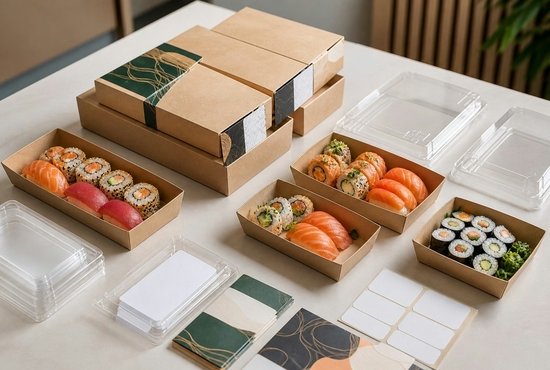
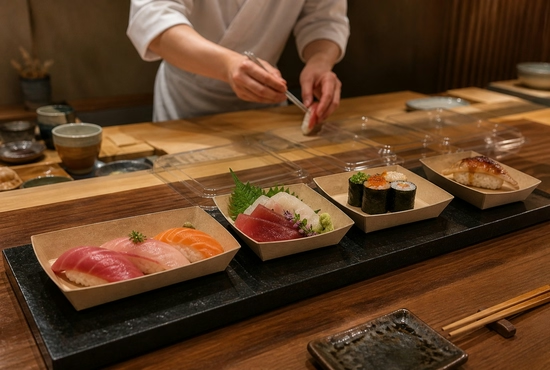
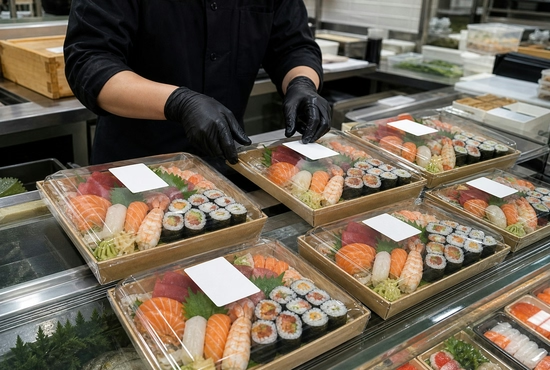
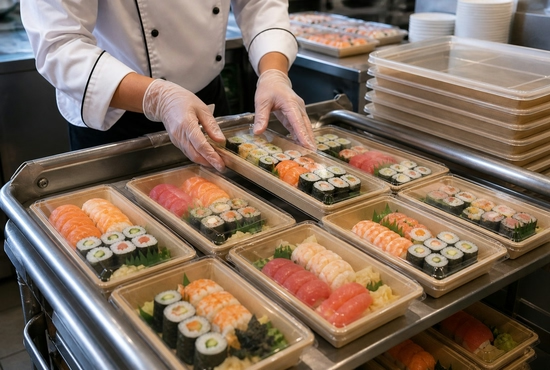

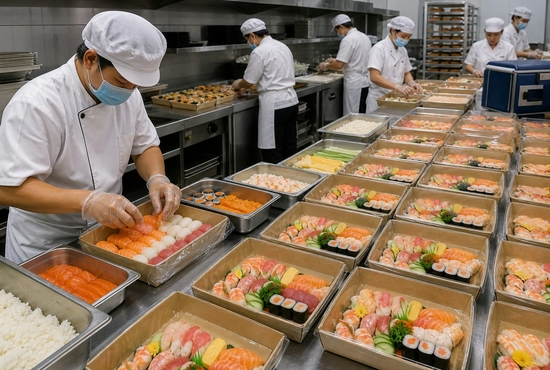
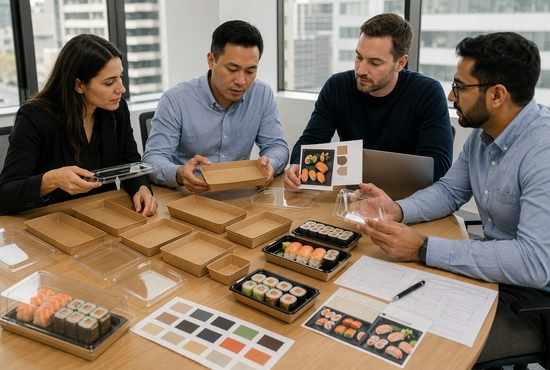
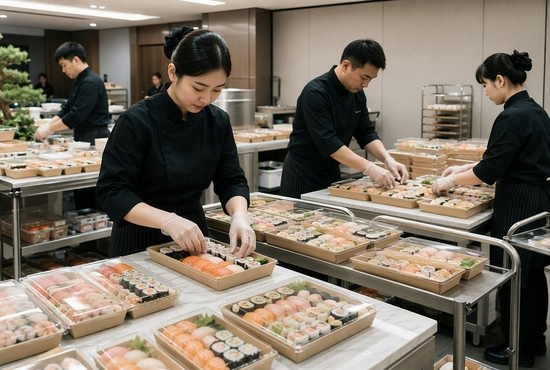
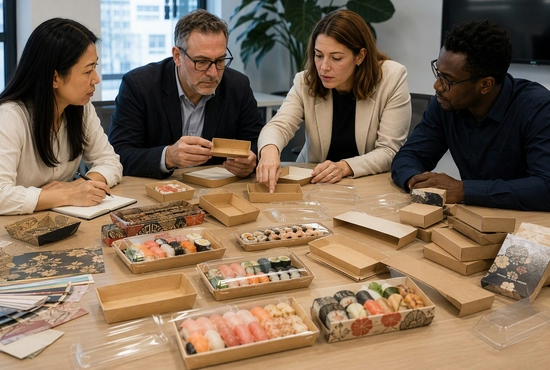
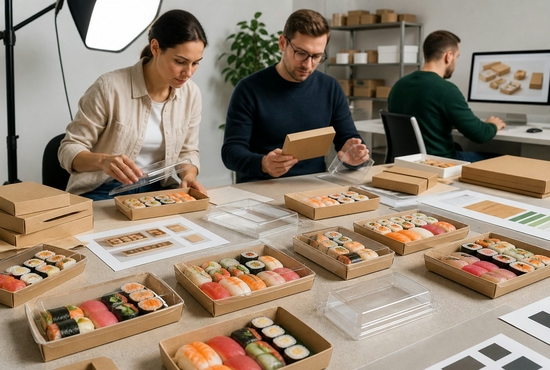
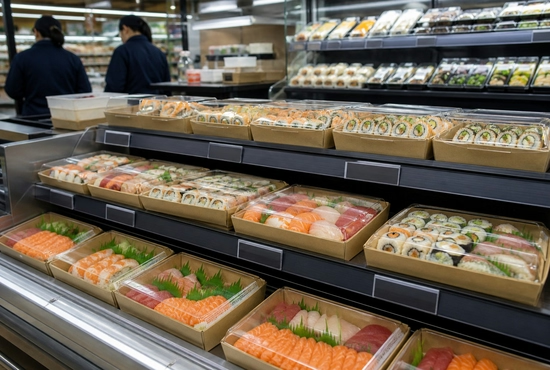
Choose the format by mapping the complete use cycle: component storage, tray and lid separation, sushi loading, chilled holding, labeling, stacking, carrying, customer use, and the intended collection route.
Paper sushi trays are usually suitable for sushi restaurant takeaway, chilled retail assortments, catering, tasting portions, private-label packaging, and delivery systems that have passed food-fit and transport testing.
Application | Recommendation |
Sushi restaurant takeaway and counter handoff | ✓ Recommended after food-fit and cover testing |
Nigiri, maki, rolls, sashimi, and combination sets | ✓ Recommended when usable area and food height are verified |
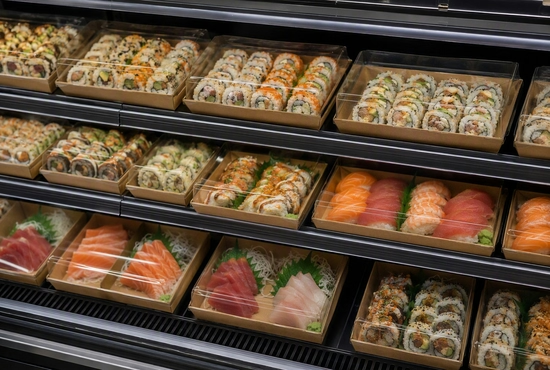
Supermarket and convenience-store chilled display | ✓ Recommended after shelf-cycle, condensation, label, and stacking tests |
Catering, hotel, and event service | ✓ Recommended when staging, carrying, and cover needs are confirmed |
Omakase and chef-led tasting menus | ✓ Recommended when compact sizes fit each course and edge presentation is approved |
Asian grocery delicatessens and chilled meal kits | ✓ Recommended after shelf-cycle, label, condensation, and matched-lid testing |
Premium rail, cruise, and airport-lounge catering | △ Conditional; validate transport, stacking, service rules, and waste handling |
Custom-printed restaurant or private-label programs | ✓ Recommended when artwork, materials, MOQ, and documents are approved |
Delivery service | △ Conditional; validate lid closure, stacking, food movement, labeling, and transport |
High-condensation or long chilled holding | △ Conditional; verify barrier, edges, stiffness, and complete duration |
Microwave, oven, or hot holding | ✗ Not assumed; use only with SKU-specific written evidence |
Soup or prolonged liquid storage | ✗ Not recommended for a standard paper sushi tray |
Integrated airtight or tamper-evident sealing | ✗ Compare a purpose-designed sealed packaging system |
Universal recyclable or compostable claim | ✗ Not appropriate; evaluate every component and local infrastructure |
They are conditionally suitable for high-condensation, long-display, or multi-component applications when the selected barrier, lid, labels, and secondary packaging have been validated.
They are usually not the first choice for soup, prolonged liquid storage, direct oven or microwave use, unsupported heavy platters, or applications requiring an integrated airtight seal that the selected system cannot provide.
DAILYECO can review assortment dimensions, piece count, garnish height, temperature, condensation, holding time, display or delivery route, artwork, packing, lid requirements, and destination-market documentation.
A quotation is meaningful only when suppliers price the same specification. Buyers should define the assortment, dimensions, paperboard, barrier, cover system, print, pack count, quality criteria, documentation, delivery term, and forecast.
The following questions help create a comparable and auditable purchasing brief.
What Information Is Required for an Accurate Quotation?
Provide the target tray dimensions or drawing, usable food area, piece count, food height, paperboard color and weight, barrier requirement, lid or secondary package, artwork, order quantity, pack count, destination, Incoterm, food-contact documents, and intended chilled conditions.
For custom development, also provide sushi or food dimensions, sauce-cup position, annual forecast, acceptable tolerances, desired sample date, launch date, and final packing requirements.
How Is MOQ Determined?
MOQ depends on whether the buyer selects a standard plain size, custom paperboard or surface treatment, custom printing, a matched lid, a private-label pack, or a new die-cut structure.
Printing method, setup waste, material procurement, artwork changes, cover sourcing, and carton configuration can each affect the commercial minimum. Confirm MOQ by base, lid, SKU, and artwork.
How Long Does Custom Development Take?
The schedule can include requirement review, structural drawing, paperboard and barrier selection, die-line development, lid matching, print proofing, sample making, real-food testing, revisions, approval, material booking, and production planning.
Ask the supplier to separate development time, production lead time, and shipping time.
Should Buyers Approve Samples Before Mass Production?
Yes. Test the sample with the actual sushi, portion, garnish, sauce cup, temperature, condensation, holding time, label, lid, stacking, carrying method, display, delivery route, and disposal message.
How Should Buyers Plan Carton Packing and Container Loading?
Compare bases and lids per carton, carton dimensions, gross and net weight, pallet pattern, container quantity, freight per thousand sets, warehouse space, and the risk of component imbalance.
A slightly higher piece price can produce a lower landed cost when nesting, case utilization, damage rate, lid compatibility, and handling efficiency are better.
What Should Be Included in the Purchase Contract?
Identify the base and cover SKUs, drawing revisions, approved samples, paperboard and barrier, lid material, artwork version, color standard, tolerances, pack counts, carton marks, inspection method, documents, lead time, delivery term, change control, and remedy for nonconforming goods.
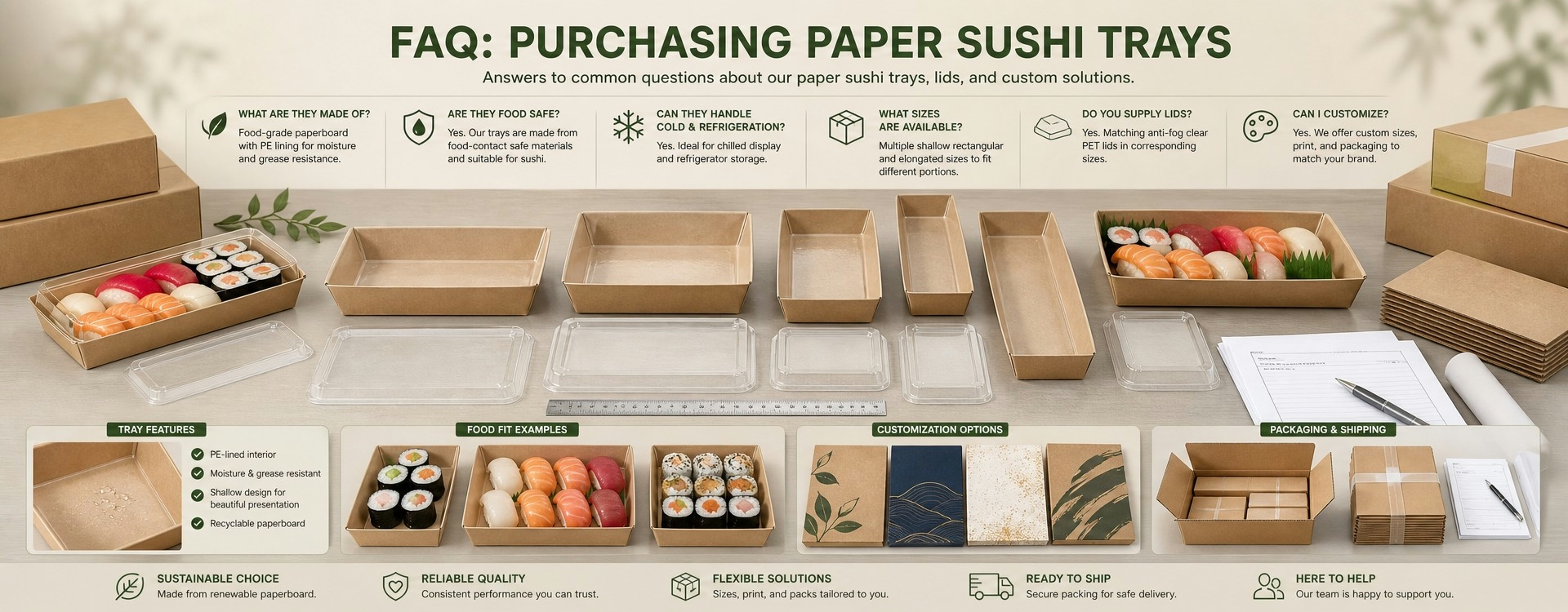
A paper sushi tray can be useful for many chilled-food presentations, but it does not provide every moisture barrier, closure, stacking, automation, or end-of-use function.
A balanced product page should state these limits clearly so buyers can compare packaging systems without treating every paper tray as interchangeable.
If the package must provide a validated airtight, tamper-evident, or high-security closure, a standard paper base plus loose cover may not be sufficient.
Paper sushi trays are normally intended for a defined chilled-food and service period. Prolonged condensation, sauce leakage, thawing, or high-moisture contact may require a different barrier or base material.
Direct oven or microwave use, open-flame exposure, unusually heavy platters, automated heat sealing, long-distance transport, or high stacking loads may exceed the intended use of a standard paper sushi base.
A commodity plastic tray-and-lid set may have a lower initial price in some markets. Unit price alone, however, does not capture presentation, printing, component balance, cartons, freight, storage, waste, handling, or customer experience.
A buyer planning A buyer planning to use fully compostable wording must confirm the lined materials, for different market have the different requirement on “Compostable”, but customize lined material is possible from DAILYECO.

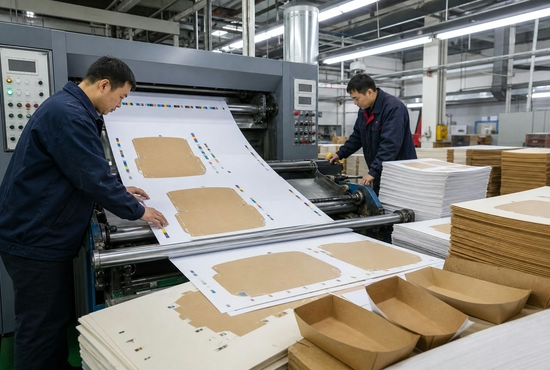
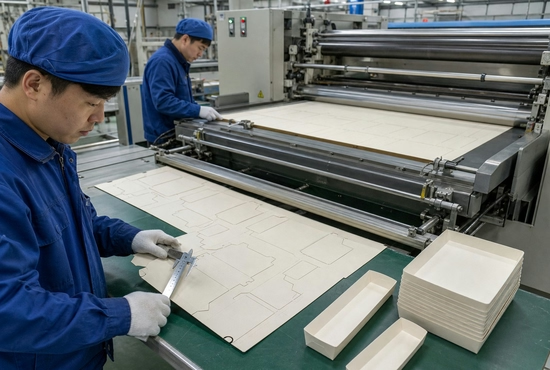
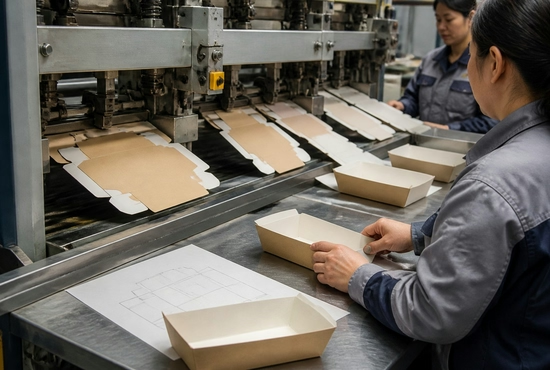
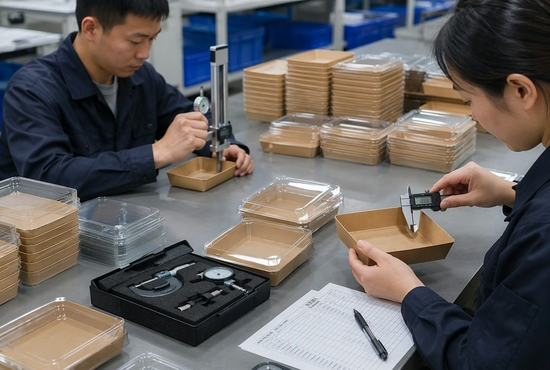
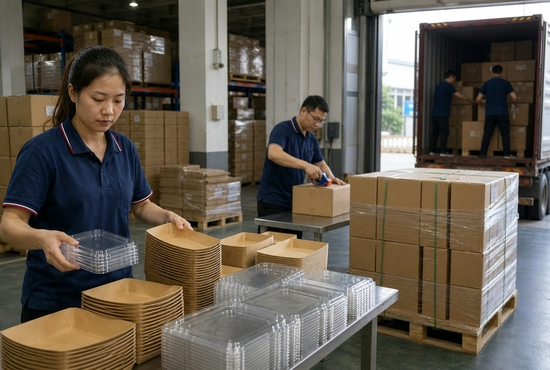
A suitable manufacturer should understand paperboard converting, chilled-food applications, lid and secondary-packaging coordination, custom printing, material documentation, quality control, packing optimization, and export execution.
The selection decision should be based on the supplier’s ability to reproduce the approved specification and component fit over time, not only on the first sample or lowest quotation.
Evaluate the following capabilities before approving a partner.
Experience with kraft paper tray, white paperboard, and printed presentation formats affects crease design, forming, corner quality, nesting, print registration, barrier selection, and cover compatibility.
Ask for examples of comparable chilled-food structures, the normal board and barrier options, and the controls used when a paperboard specification or lid source changes.
Capacity should be evaluated by the ordered base, lid, printing method, material availability, season, maintenance plan, and current workload.
Request realistic lead times, material-booking requirements, surge-capacity limits, component-balance controls, and a repeat-order plan rather than relying on one factory-wide number.
Different assortments and channels require different sizes, usable areas, rim profiles, barriers, covers, artwork, labels, and packs.
A professional supplier should support standard paper sushi trays and explain when a new die line, board grade, barrier, surface finish, or print specification is commercially justified.
Relevant capabilities include standard size selection, custom dimensions, die-line and prototype development, paperboard and barrier review, cover matching, custom printing, private-label cartons, and foodservice or retail packs.
For a unique assortment or brand format, die-line development determines usable area, top and bottom dimensions, rim profile, depth, corners, folds, lid interface, nesting, and printable panels.
The supplier should be able to convert buyer requirements into a dimensioned drawing, compatible component specification, and testable sample.
Commercial sushi packaging requires consistent material, converting, inspection, traceability, hygiene, and change-control procedures.
The supplier should control the approved board, barrier, ink, adhesive, die-line revision, dimensions, appearance, print, cover reference, pack count, and carton condition.
Typical checks include incoming paperboard identity and condition; top, bottom, depth, and usable-area measurements; board weight and stiffness where specified; rim, corner, print, odor, and appearance inspection; lid compatibility; pack count; and carton marks.
International buyers benefit from suppliers that understand export cartons, balanced base-and-lid quantities, pallet and container loading, commercial documents, destination labels, and delivery-term responsibilities.
Confirm who controls freight booking, documents, origin information, inspection, component coordination, and shipment updates.
Good communication converts an informal packaging idea into a controlled, comparable, and testable specification.
A supplier should explain tradeoffs among food area, board weight, barrier, cover fit, print coverage, packing, MOQ, lead time, performance, and cost.
Before placing an order for paper sushi trays, buyers should review the following checklist to ensure that the selected products meet their food application, market, compliance, customization, and supply-chain requirements.
□ Required Paper Sushi Trays Type and Matching Lid
□ Food Application Requirements (Restaurant / Takeaway / Delivery / Chilled Retail / Catering / Private Label)
□ Sushi Assortment, Piece Count, and Serving Requirements
□ Required Tray Size and Food Capacity
□ Top, Bottom, Height, Usable Area, and Lid-Clearance Requirements
□ Kraft Paper, Basis Weight, and PE-Lining Specifications
□ Anti-Fog PET Lid Material and Size Requirements
□ Base-and-Lid Fit, Closure, and Stacking Requirements
□ Product Appearance, Edge, Fold, and Surface-Quality Standards
□ Chilled-Holding and Condensation-Resistance Requirements
□ Moisture-, Sauce-, and Oil-Resistance Requirements
□ Food-Contact Compliance for the Tray, PE Lining, and PET Lid
□ Destination-Market Regulations
□ Recycling, Sustainability, and Environmental-Claim Documentation
□ Customization Requirements (Size / Logo / Sleeve / Label / Private-Label Carton)
□ Artwork, Color, Barcode, and Label-Position Requirements
□ OEM and ODM Development Requirements
□ Actual-Food, Lid-Fit, Chilled-Storage, and Transport Testing Before Mass Production
□ Minimum Order Quantity for Trays, Lids, and Custom Artwork
□ Annual Purchasing Forecast
□ Sample, Production, and Reorder Lead Time
□ Inner Packing, Pieces per Carton, and Base-to-Lid Quantity Ratio
□ Carton Dimensions, Shipping Marks, and Export-Packing Requirements
□ Pallet and Container-Loading Efficiency
□ Product Inspection, Acceptance Criteria, and Factory-Audit Requirements
□ Payment, Incoterm, Delivery, and Required Export-Document Terms
Completing this checklist before sampling and production can reduce communication errors, mismatched tray-and-lid quantities, specification changes, and avoidable procurement risks.
Buyers should attach the approved tray and lid drawings, physical sample references, material specifications, artwork, packing requirements, compliance-document list, inspection standards, and delivery terms to the final order for paper sushi trays.
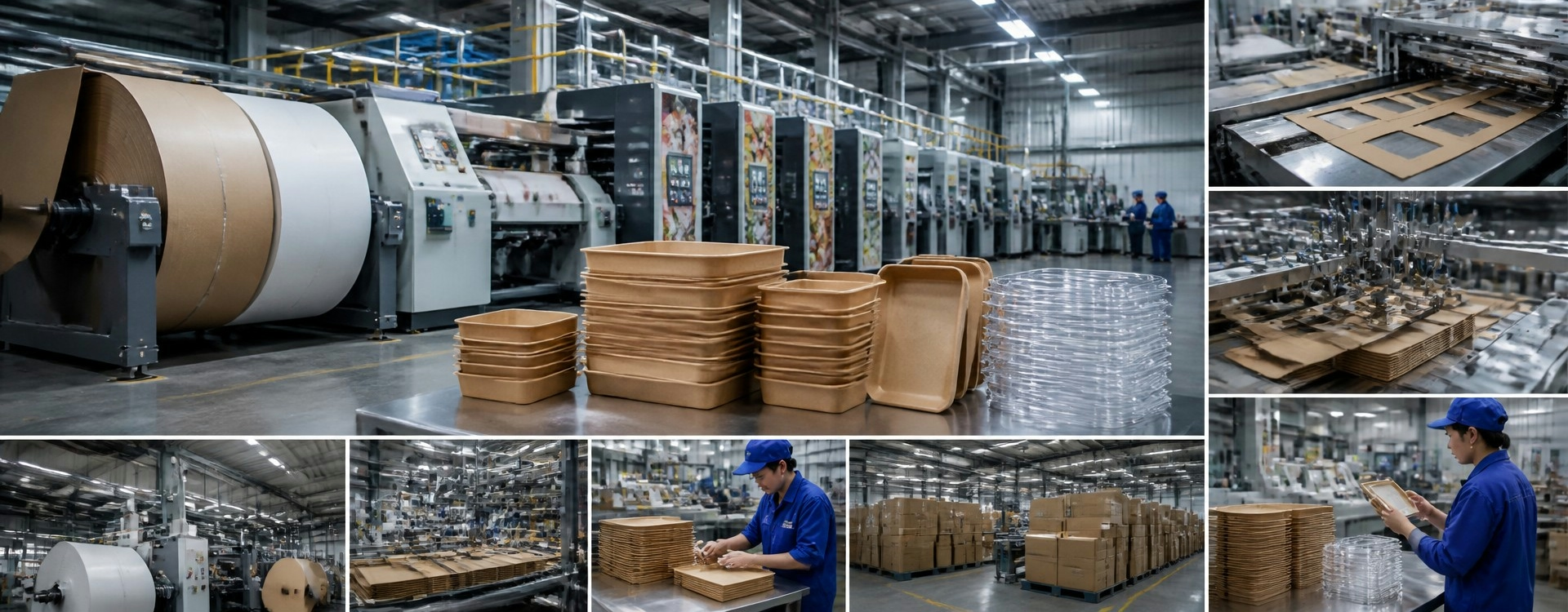
DAILYECO supports sushi restaurants, packaging distributors, importers, foodservice companies, caterers, retailers, and private-label brands sourcing paper sushi trays.
Item | Description |
Manufacturing Facility | Professional paper food packaging production facility specializing in paperboard converting, printing, die cutting, creasing, folding, and tray forming |
Employees | More than 1,000 employees |
Production Capability | Standard and custom paper sushi trays in multiple sizes, paperboard options, barrier specifications, printing designs, and packing configurations |
Monthly Supply Capacity | Monthly production capacity of up to 11 million pieces, supporting stable large-volume export orders |
Product Range | Paper sushi trays, paper boat trays, paper food trays, hot dog paper trays, and customized paperboard food-packaging trays |
Material Capability | Kraft and white paperboard with product-specific basis weights, stiffness levels, food-contact specifications, and grease- or moisture-barrier options |
Product Development | Custom tray dimensions, structural design, die-line development, barrier selection, printing development, and packaging optimization |
Manufacturing Process | Paperboard preparation, printing, die cutting, creasing, folding, tray forming, quality inspection, counting, and carton packing |
OEM | Custom logos, printing, artwork, labels, retail packs, inner packaging, master cartons, and private-label solutions |
ODM | Paper sushi tray structure development, dimension optimization, paperboard and barrier selection, and customized food-packaging development |
Technical Support | Professional support for product selection, food-application evaluation, sample testing, specification confirmation, and packaging development |
Production MOQ | Flexible according to product size, paperboard specification, printing, packing, and customization requirements |
Typical Lead Time | Approximately 25–35 days for customized orders |
International buyers should request documentation that matches the exact paperboard, barrier, ink, adhesive, tray, cover, food type, conditions of use, and destination market.
DAILYECO can coordinate available food-contact, material, testing, and sustainability-related information for the selected SKU. The separate compliance page can provide the appropriate certificate and documentation route without overloading this collection page.
Every document should be checked for product identity, component scope, conditions of use, issue date, validity, destination-market relevance, and whether it supports the intended website or packaging claim.
View Our Compliance & Certification Support Page
Different assortments, brands, and channels require different paper tray specifications.
DAILYECO supports custom paper sushi trays and private-label packaging subject to technical and commercial feasibility.
The process links food fit, structure, cover, artwork, packing, testing, and written approval before mass production.
For export orders, DAILYECO can support carton specification, balanced component planning, loading review, shipping marks, commercial-document coordination, and production updates.
Buyers should confirm base and cover scope, destination, Incoterm, port, timeline, and document list at quotation stage.
Support begins with requirement clarification and continues through sample, approval, production, shipment, and repeat-order review.
Clear written records help both sides manage revisions and repeat orders consistently.
Quality consistency matters when large quantities of paper trays and matched covers are used across customers or locations.
The final inspection scope and acceptance criteria should be agreed before production.
Sushi packaging requirements evolve with menus, delivery channels, chilled-display practices, coating technology, printing, regulation, collection systems, and customer expectations.
DAILYECO works with buyers to review feedback and identify practical improvements to food fit, structure, material, cover, print, packing, and supply planning.